


Can You Build a CMHC Catalogue Home in Vancouver? Here’s What It Really Takes
- Reggie MacIntosh
- Oct 25, 2025
- 8 min read

Updated: Oct 26, 2025


imagery and plans pulled from CMHC HOUSING DESIGN CATALOGUE: BC ACCESSORY DWELLING UNIT 01 & BC SIXPLEX COURTYARD. Not for permit or construction.
A Streamlined Concept With Some Familiar Challenges
In mid-October, the Canada Mortgage and Housing Corporation (CMHC) released its much-anticipated Housing Design Catalogue — a national library of pre-designed homes aimed at cutting approval timelines and making construction more predictable.
The idea is simple: rather than starting from scratch, homeowners and builders can choose from a set of standardized, energy-efficient designs that have already been developed by qualified professionals and vetted for energy efficiency and code standards for specific regions in the country. Several cities — including Vancouver and Burnaby — have signed on to pre-review these plans to help streamline the permitting process.
It’s an exciting concept--one that speaks to me considering my background as an architect in Ontario. But like many housing ideas that sound straightforward on paper, things in Vancouver, and in reality are rarely that simple. So, can you actually build one of these catalogue homes here in Vancouver — and what would it really take to make it happen?
What the CMHC Housing Design Catalogue Actually Is
Think of the CMHC catalogue as a menu of architectural templates — not permit-ready blueprints. Each package includes full floor plans, elevations, general and typical construction details, basic structural, mechanical, and electrical drawings, and energy-efficiency targets. The designs were created to be flexible and to allow for unique finishes and personality.
Every plan also meets a high bar for performance. In B.C., the catalogue homes are designed to achieve Step 4 of the BC Energy Step Code and Level 4 of the Zero Carbon Step Code, meaning they’re built for efficiency, durability, and comfort. Many also incorporate adaptable layouts that make aging-in-place or multigenerational living easier — an increasingly relevant need in Vancouver’s tight housing market.
But here’s the key detail:
These are starting points, not ready-to-build homes.
Each design must still be adapted by a qualified professional — typically an architect, technologist, or engineer — to suit your specific site, zoning, and local regulations. CMHC itself notes that cities will review these projects using the same permitting framework as any other new home. The benefit is mainly in time savings on design, but not in skipping it all together. The intent is that municipal review will also be streamlined but, that also depends on any changes made to the design and whether or not the property is a "perfect fit" zoning and bylaw-wise for design selected. Think of these as well-designed blueprints — not ready-to-build kits. Every property still needs a tailored approach.
Below, I've summarized who this catalog is for, what it means to implement in Vancouver, what the catalog is missing, and what your next steps should be if you're thinking of developing your property, or finding one to develop.


Imagery and drawings pulled from CMHC HOUSING DESIGN CATALOGUE: BC ROWHOUSE. Not for permit or construction.
Who These Designs Are For (and Why They Matter)
The catalogue’s biggest strength is accessibility. It gives homeowners and small developers a clearer roadmap for what’s possible without committing to full custom design fees.
For homeowners, it could simplify the path to adding a garden suite or laneway home — provided your lot and zoning allow it.
For buyers, it’s a way to evaluate properties differently: not just what exists today, but what could be added.
For sellers, knowing that your lot could support a pre-approved design might become a valuable selling point in the years ahead.
Fore developers, it's an opportunity to evaluate properties in more streamlined manner. With pre-designed, and nearly pre-approved layouts, the feasibility stage can be slightly shortened when reviewing potential properties.
In a city where construction and permitting can feel overwhelming, the catalogue is a practical bridge between federal ambition and local feasibility — a visual, tangible way to start the conversation about adding gentle density and new opportunities, but not an automatic shortcut.


Renderings pulled from CMHC HOUSING DESIGN CATALOGUE: Fourplex, Duplex, and ADU 02.
The Vancouver Reality Check
Even with a set of pre-designed plans ready to go, building in Vancouver still means navigating a complex local process. The CMHC catalogue provides a strong foundation to start from during the design stage but everything else that makes construction here challenging still applies.
The first hurdle is zoning and site fit. Vancouver’s patchwork of residential districts means that not every lot can accommodate every type of home. A plan that works perfectly within the catalog will need adjustments to meet local height limits, setbacks, or lane-access rules. Before anyone starts printing drawings, a qualified technologist or architect has to confirm with the authorities having jurisdiction, like the City of Vancouver or the City of Burnaby, that the chosen plan aligns with what’s actually permitted on the site.
Then comes permitting. The City still requires development and building permits, even for catalogue-based projects. The advantage is that the design itself may raise fewer technical questions, which could save some review time — but property owners should still expect several months of back-and-forth before approvals are complete. Remember, the review process not just about the design of the building and its conformity to zoning and building codes, the building also needs to be fully integrated on the site — think site drainage, power and sewer service connections, parking, existing site conditions, and even tree protection measures. There are many departments involved in the review of a "simple" laneway house.
And finally, there’s market reality. Construction costs, interest rates, and contractor availability continue to shape what’s feasible. The pandemic and recent tariffs have driven construction and material costs up and has made budgeting a challenge. Even if approvals move faster, financing a new build or infill project can still be difficult in a slow market. For many homeowners, that means the value of the catalogue right now lies more in readiness than immediacy — it’s a way to plan intelligently and be prepared when conditions improve.

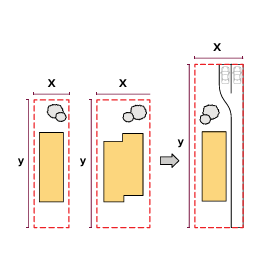

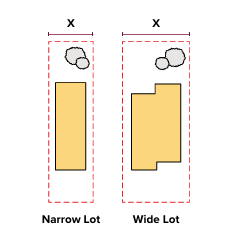


Diagrams pulled from CMHC HOUSING DESIGN CATALOGUE USER GUIDE. Diagram show simplified typology layouts on different lot sizes.
What Is Not Included In The Catalog
Not to be forgotten in this process is the detail design of your project. The CMHC catalogue provides general drawings and details that can be adapted for permit purposes but does not include any finish specifications.
ou’ll still need to make decisions about materials — both inside and out. What cladding will you use: wood, metal, or another type of panel? Do those materials meet local code and align with the intent of the catalogue drawings? And what about interior finishes — flooring, tile, cabinetry, paint colours, lighting, and plumbing fixtures?
Some of these choices can wait until after your permit application is underway, but others — particularly exterior finishes — need to be determined early so your designer can incorporate them into the permit set. Beyond timing, these selections have a significant impact on your budget and positioning. While finishes aren’t the largest line item in most builds, they strongly influence perceived quality and cost.
If you’re a homeowner building for yourself, your choices come down to lifestyle and long-term durability. If you’re a small-scale developer or planning to sell, it’s worth asking: Who am I building for, and what level of finish will that buyer expect? Understanding that balance early helps you stay realistic about both costs and market appeal..

What You Need to Do (Your Step-by-Step Roadmap)
The CMHC catalogue can make the early stages of planning much simpler — but it’s not a plug-and-play solution. Turning a catalogue design into a real home still means following the same key steps as any other project. Here’s how to approach it thoughtfully.
Assemble Your Team Early
Whether you already own the property you're planning on developing or you are just starting to search for the right fit, you’ll need a few key professionals:
A designer, architect, or technologist to adapt the catalogue plan for your specific lot or to evaluate potential lots with you.
A survey and engineering consultant to confirm site conditions and servicing requirements.
A builder or contractor to estimate costs and feasibility.
And ideally, a Realtor® to help assess how the project will add value, or what buyers in your market will expect when it’s complete.
Engaging your team early helps prevent costly design changes later and ensures your permit submission is complete the first time.
Choose a Design That Fits Your Goals
Review the catalogue to find a plan that suits both your property and your objectives. Are you hoping to create a laneway home, a secondary suite, or a small multi-unit building? Think about who the end user will be — a family member, tenant, or buyer — and what type of layout makes sense.
This step might have been started before assembling your team, and that's fine too. Having an idea of your goals is a great way to get started. Your team is there to help evaluate your goals against the realities of development in Vancouver. If you've done this step first, just don't get too locked-in on a design as flexibility will be necessary.
3. Confirm Lot Readiness
Before adapting the design, confirm that your lot’s zoning and dimensions align with your chosen plan type. Check setbacks, access, and any potential site constraints such as trees, slopes, or servicing upgrades. This step determines whether the project will move smoothly through permitting or require adjustments. Lean on your team of professionals to help you - that's what they're there for.
4. Adapt and Submit
Your design professional will modify the CMHC drawings to reflect your site, local bylaws, and building code requirements. Once finalized, the team can submit the project for review and permitting. The CMHC plans are meant to simplify this step — but they don’t replace it.
5. Plan Your Budget and Timeline
While the catalogue reduces upfront design costs, the overall project will still depend on construction pricing, material choices, and market conditions. Build in time for reviews, pricing, potential city comments, and detail design. A realistic timeline — and a clear financial plan — are essential to avoid surprises.
6. Leverage the Value
Even if you’re not ready to build right away, understanding what’s possible with your lot can strengthen your position.
Sellers: A property with proven design potential can be a meaningful selling point. You don't need to be permit ready however, a strong feasibility study could be a big asset.
Buyers: A lot with a ready-to-adapt plan offers more certainty.
Homeowners: A plan in place makes future construction faster when the timing is right.
Is Your Lot CMHC-Ready?
If you own or are searching for a property and have wondered what else might be possible — a laneway home, an infill suite, or a small multi-unit dwelling — now’s a good time to explore your options. The CMHC catalogue can be a great starting point, but success depends on how well a design fits your lot, your goals, and your market.
Curious if your property is CMHC-ready? I’ve created a quick checklist to help homeowners and small developers evaluate what’s possible.
As both a REALTOR® and an architect in Ontario (not practicing in BC), I help clients see beyond what’s there today — to the potential that smart design and good planning can unlock.


Comments